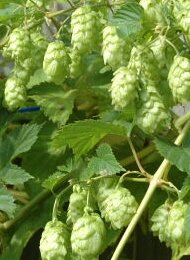
|
|
-
Pedigree: This hop is principally grown in the counties of Worcester and Hereford and is similar to Bramling.(see 'English Hops' by George Clinch (1919) page 17). In 2008, Martin Cornell wrote that the origins of the Mathon hop were a puzzle, "One source says drawings of this variety were used in porcelain factories in Worcestershire in the 1790s, and claims a plate showing the Mathon hop survives from 1794. If Mathons are a variety of Golding, 1794 seems early for them to have developed from Mr Golding’s original find as a separate variety. The Reverend Luke Booker, a poet and clergyman who had charge of parishes in both Herefordshire and Worcestershire at various times, wrote in The Hop Garden, published in 1799, that "thy preference demand/The Mathon-White, and far-fam’d Golding-Bine" suggesting he was familiar with seeing both types growing locally. Both “the Golding vine” and “Mathon-White” are named in A General View of the Agriculture of the County of Worcester, published in 1810, as growing locally. In 1826 the “Mathon white” was described as “superior to any other. It not only affords a more pleasant and mild bitter, but a much more pleasant aroma than the Kent or any other Worcestershire hop.” My personal suspicion is that the Mathon white was, like the Golding, descended from the Canterbury White-bine, and that accounts for the Mathon being put later in the Goldings family."
- General Trade Perception:
-
Possible Substitutions: Bramling, Kent Golding, Progress, Whitbred's Golding Variety (WGV)
-
Beer Styles: ESB, Bitter, Pale Ale.
-
Maturity: Main crop.
- Yield:
- Growth Habit:
- Disease Reaction:
-
Pickability: Fair to good.
-
Lupulin: Plentiful.
-
Cone Structure: Good size, firm and compact.
-
Aroma: Pleasant aroma, characteristic of the best Golding hops.
| Alpha Acids(%) |
|
Beta Acids (%) |
|
| Alpha/Beta Ratio |
|
Co-Humulone (%) |
|
| Humulone |
|
Storage (% lost) |
|
| Oil Content (mls/100g) |
|
Humulene ( % in oil) |
|
| Caryophyllene |
|
Hum/Cary Ratio |
|
| Farnesene |
|
Myrcene |
|
|
 Home
Home